Bresenham's Line Algorithm
This algorithm is used for scan converting a line. It was developed by Bresenham. It is an efficient method because it involves only integer addition, subtractions, and multiplication operations. These operations can be performed very rapidly so lines can be generated quickly.
In this method, next pixel selected is that one who has the least distance from true line.
The method works as follows:
Assume a pixel P1'(x1',y1'),then select subsequent pixels as we work our may to the night, one pixel position at a time in the horizontal direction toward P2'(x2',y2').
Once a pixel in choose at any step
The next pixel is
- Either the one to its right (lower-bound for the line)
- One top its right and up (upper-bound for the line)
The line is best approximated by those pixels that fall the least distance from the path between P1',P2'.
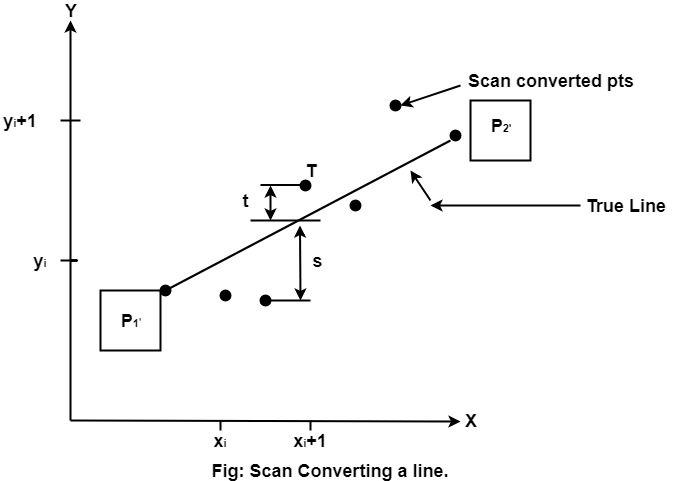
To chooses the next one between the bottom pixel S and top pixel T.
If S is chosen
We have xi+1=xi+1 and yi+1=yi
If T is chosen
We have xi+1=xi+1 and yi+1=yi+1
The actual y coordinates of the line at x = xi+1is
y=mxi+1+b
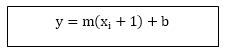
The distance from S to the actual line in y direction
s = y-yi
The distance from T to the actual line in y direction
t = (yi+1)-y
Now consider the difference between these 2 distance values
s - t
When (s-t) <0 ⟹ s < t
The closest pixel is S
When (s-t) ≥0 ⟹ s < t
The closest pixel is T
This difference is
s-t = (y-yi)-[(yi+1)-y]
= 2y - 2yi -1

Substituting m by  and introducing decision variable
di=△x (s-t)
di=△x (2 (xi+1)+2b-2yi-1)
=2△xyi-2△y-1△x.2b-2yi△x-△x
di=2△y.xi-2△x.yi+c
Where c= 2△y+△x (2b-1)
We can write the decision variable di+1 for the next slip on
di+1=2△y.xi+1-2△x.yi+1+c
di+1-di=2△y.(xi+1-xi)- 2△x(yi+1-yi)
Since x_(i+1)=xi+1,we have
di+1+di=2△y.(xi+1-xi)- 2△x(yi+1-yi)
Special Cases
If chosen pixel is at the top pixel T (i.e., di≥0)⟹ yi+1=yi+1
di+1=di+2△y-2△x
If chosen pixel is at the bottom pixel T (i.e., di<0)⟹ yi+1=yi
di+1=di+2△y
Finally, we calculate d1
d1=△x[2m(x1+1)+2b-2y1-1]
d1=△x[2(mx1+b-y1)+2m-1]
Since mx1+b-yi=0 and m = , we have
d1=2△y-△x
Advantage:
1. It involves only integer arithmetic, so it is simple.
2. It avoids the generation of duplicate points.
3. It can be implemented using hardware because it does not use multiplication and division.

Comments
Post a Comment